
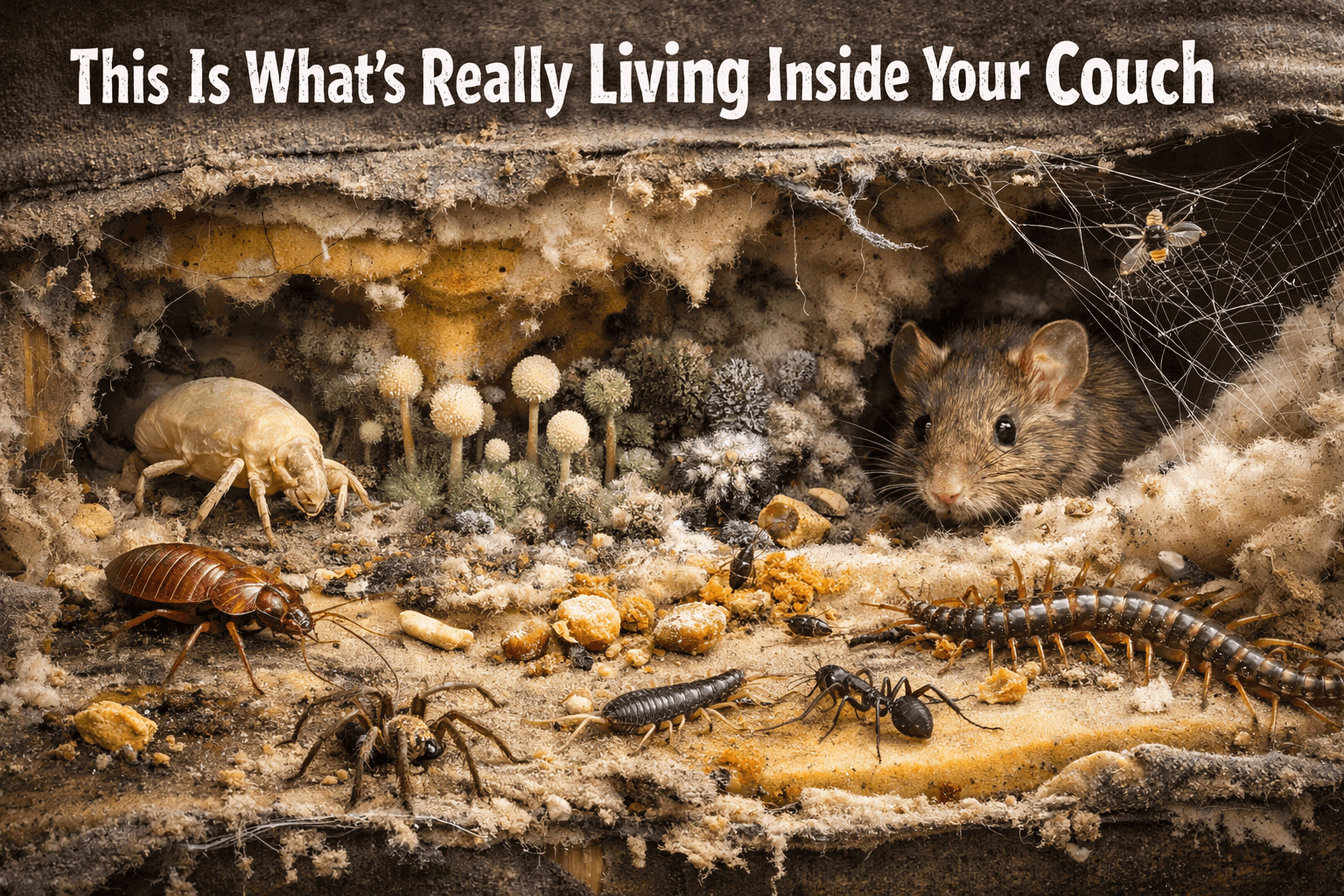
Your couch looks fine. Comfortable. Maybe a little worn in spots, but that’s character, right? You vacuum the cushions occasionally. Spot-clean spills. Flip the cushions when one side gets too flattened.
What you can’t see is the ecosystem thriving in those fibers. The biological reality of what accumulates in upholstered furniture over months and years of use. Let’s pull back the literal cushions and look at what’s really there.
The Dust Mite Metropolis
Dust mites love your couch even more than you do. It’s perfect for them – warm from body heat, supplied with endless food (your dead skin cells), protected from disturbance in deep crevices.
A typical couch can harbor millions of dust mites. Not hundreds. Not thousands. Millions. They’re microscopic, so you’ll never see them. But they’re there, feeding, reproducing, defecating constantly.
Each mite produces about 20 fecal pellets daily. These pellets and decomposed mite body parts become airborne when you sit down, creating that satisfying “poof” of disturbed cushion. You’re not just sitting – you’re launching allergens into the air you breathe.
Not allergic? Doesn’t matter. You’re still inhaling waste products and decomposed arthropods. Every. Single. Time. You. Sit. Down.
The Food Particle Graveyard
Crumbs don’t just disappear. They migrate downward through cushion gaps, settling in crevices and beneath cushions where they decompose slowly.
Popcorn fragments. Cookie crumbs. Chip pieces. Bits of meals eaten while watching TV. They all end up in the depths of your couch, creating a buffet for bacteria, mold, and occasionally insects.
That stale smell you’ve stopped noticing? Decomposing food particles. Mixed with body oils. And whatever else has accumulated. Your nose adapted, but the smell remains for anyone visiting your home for the first time.
Pet Dander Central Station
Even if you don’t have pets, your couch contains pet dander. It travels on clothes from friends’ homes, from public spaces, from anywhere you’ve been. And it sticks to upholstery with remarkable tenacity.
If you do have pets, multiply the problem exponentially. Dogs and cats shed constantly. Dead skin cells, fur, oils from their coat – all embedding deep into couch fibers where regular vacuuming can’t reach.
Pet dander causes allergic reactions in roughly 10% of the population. Your couch might be triggering symptoms in guests without anyone making the connection. You’ve adapted to baseline allergen exposure, but visitors haven’t.
The Sweat and Body Oil Reality
Every time someone sits on your couch, they leave behind traces. Sweat from backs and legs. Oils from skin and hair. Dead skin cells constantly shedding. Bacteria from all of the above.
Over months, this accumulates into a grimy coating on fabric surfaces. You don’t see it because the change is gradual. But compare your couch’s original color to its current state. That darkening, especially on armrests and headrests? Body oils and dirt.
Cotton and polyester fibers absorb and trap these substances. Professional analysis of “clean-looking” couches routinely finds disturbing levels of human biological material embedded in fabric.
What Lives in the Cracks
Couch crevices are archaeological sites of everyday life. Things fall there and remain indefinitely:
- Food crumbs attracting insects
- Coins and small objects
- Pet hair clumps
- Dust accumulation creating compressed masses
- Spilled liquids dried into sticky residue
- Sometimes live insects or their remains
- Biological material too gross to specify
When did you last clean between and under cushions? Really clean, not just a quick vacuum pass? If the answer is “never” or “don’t remember,” you’re harboring years of accumulated contamination.
The Mold Factor Nobody Considers
Spilled drinks don’t just affect surface fabric. Liquid seeps into cushion foam, creating moisture pockets perfect for mold growth. That dampness takes forever to fully dry in cushion interiors.
Mold grows in these hidden areas, releasing spores into your air. You might never see visible mold on your couch while breathing mold spores regularly. Respiratory issues, allergies, unexplained health complaints – the source might be sitting in your living room.
Humid climates make this worse, but it happens anywhere moisture meets organic material in dark, undisturbed spaces. Your couch provides ideal conditions.
The Bacteria Cocktail
Studies suggest couches can contain more bacteria than toilet seats. Sounds dramatic, but consider the logic – you clean toilet seats regularly. When did you last disinfect your couch?
E. coli, Staphylococcus, various other bacteria live happily in upholstery. They feed on organic material, multiply in warm conditions, and transfer to your skin and clothes every time you sit.
Your couch isn’t sterile. It’s a bacterial ecosystem that gets disturbed and reseeded constantly but never properly sanitized unless you take specific action.
The Chemical Accumulation
Everything that touches your couch leaves residue. Lotions. Hair products. Perfumes. Cleaning sprays. Pesticides tracked from outside. Volatile organic compounds from other household items.
These chemicals absorb into fabric and foam, slowly off-gassing over time. You’re breathing them. They’re contacting your skin. Children and pets spending time on the couch face higher exposure due to size and proximity.
Flame retardants in older couches pose their own health concerns. These chemicals don’t stay locked in foam – they migrate to dust and air over time.
When Spot Cleaning Makes Things Worse
You spill something, immediately blot with water, maybe use a cleaning spray. Looks fine once dry.
Except you just pushed the stain deeper into cushion layers. What looks clean on the surface has penetrated further into foam and padding. There it sits, potentially growing mold, feeding bacteria, creating odors that develop slowly over time.
Surface cleaning creates illusion of cleanliness while contamination spreads deeper. Professional furniture cleaning tackles layers consumer methods can’t touch. If you want to understand what actually works for deep upholstery care, you can click here for detailed information on techniques that genuinely clean rather than just redistribute dirt.
The Pet Accident Time Bomb
Pet urine in furniture is a nightmare. It soaks through fabric into foam and sometimes even the frame. Surface cleaning addresses smell temporarily while the source remains, continuing to decompose and spread bacteria.
Urine crystals form in cushion layers, releasing odor whenever disturbed by pressure or humidity changes. Professional enzyme treatments can break these down, but they require proper application that reaches contaminated layers.
Many people live with pet-damaged furniture they think is “clean enough” because the smell isn’t constant. It’s still there, still contaminated, still causing problems.
The Age Factor
How old is your couch? Five years? Ten? Fifteen?
The longer you’ve owned it, the more accumulated contamination exists in layers no surface cleaning reaches. Every year adds more dust mites, more body oils, more spilled substances, more ground-in dirt.
Old couches are repositories of everything that’s happened on and around them for years. Think about what yours has witnessed and absorbed. Now consider that it all lives in those cushions still.
What Professional Cleaning Actually Does
Hot water extraction for furniture works like carpet cleaning but requires expertise to avoid saturating foam. Proper technique removes:
- Deep embedded dirt and dust
- Dust mite populations
- Bacteria and biological material
- Old stains and residues
- Odors at their source
- Allergens throughout fabric
Professional drying prevents mold from forming in treated cushions. Appropriate products address different fabric types without damage. Results go far beyond what DIY methods achieve.
The Leather Myth
Leather couches avoid some issues – no dust mites living in fibers, easier surface cleaning, less absorption of biological material.
But leather has its own problems. Body oils darken and damage finish over time. Cracks accumulate dirt. Dyes transfer from clothes. Leather conditioners are necessary but often applied incorrectly or skipped entirely.
Leather furniture still needs professional cleaning and conditioning periodically. It’s not maintenance-free just because it’s not fabric.
When Replacement Makes More Sense
Sometimes furniture is beyond saving. If your couch is:
- More than 10-15 years old
- Heavily stained throughout
- Has persistent odors despite cleaning attempts
- Shows structural damage or severe wear
- Contains materials that can’t be effectively cleaned
Professional cleaning might not be worth the cost. At some point, starting fresh costs less than attempting to rehabilitate unsalvageable furniture.
The Bottom Line
Your couch contains way more than you want to think about. Dead skin cells, dust mites and their waste, food particles, body oils, bacteria, possibly mold, pet dander, chemical residues, spilled substances, and years of accumulated grime.
Regular vacuuming helps superficially. Spot cleaning addresses visible issues. But deep contamination requires professional intervention that removes what’s actually there, not just what you can see.
You spend hours on your couch daily. It’s where you relax, where kids play, where pets sleep, where you eat and work and live. It deserves more than surface maintenance.
Professional furniture cleaning isn’t about being obsessive or paranoid. It’s about acknowledging reality and dealing with it appropriately. Your couch is dirtier than you think. Now you know what to do about it.

Chase Ortiz is part of the team at PaigeSimple, where he takes care of all the advertising requests. With a sharp eye for detail, Chase makes sure every advertising opportunity is handled smoothly, helping the site grow and reach more people. His ability to manage these tasks efficiently makes him an important part of the team.