
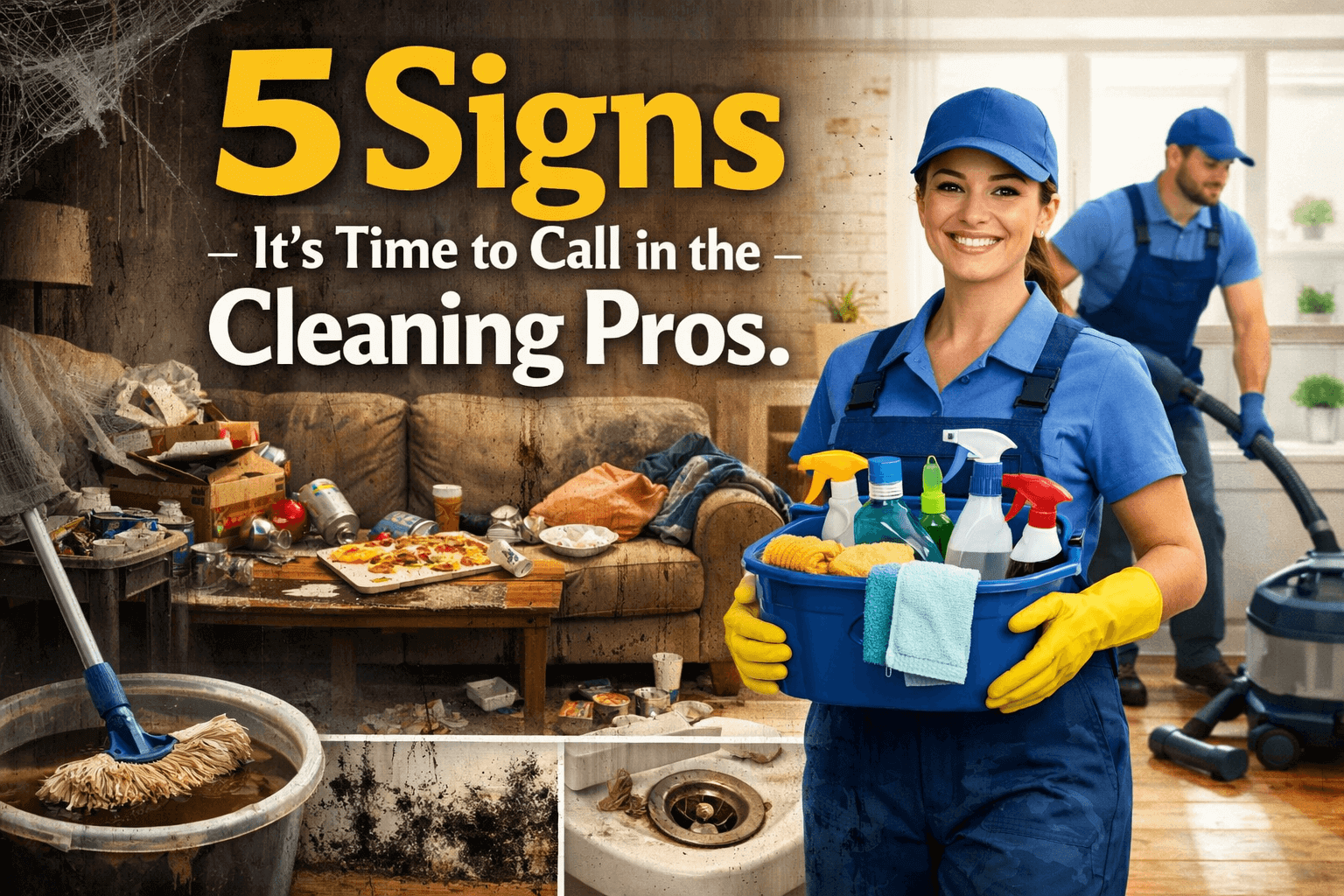
You’ve been putting it off. The house needs a deep clean, but you keep telling yourself you’ll get to it this weekend. Then next weekend. Then the weekend after that.
Meanwhile, the dust accumulates. The grime builds. The bathrooms get progressively worse. Your good intentions mean nothing to the dirt that doesn’t care about your busy schedule.
There comes a point where DIY efforts aren’t cutting it anymore. Where the gap between your house’s current state and where it should be has grown too wide to bridge with a Saturday afternoon and some all-purpose cleaner.
But how do you know when you’ve crossed that line? When does “I should really clean” become “I need professional help”?
Most people wait too long, letting problems compound until they’re dealing with situations that cost more to fix than they would have if addressed earlier. Understanding the warning signs helps you make the call before minor issues become major headaches.
For comprehensive insights into professional cleaning standards, check out cleanyourcouch.nyc for information on when and why to bring in experts.
Here are five clear indicators that it’s time to stop procrastinating and call professional cleaners.
Sign #1: You’re Actively Avoiding Certain Rooms
Be honest with yourself. Are there areas of your house you’ve basically abandoned?
That guest bathroom nobody uses because it’s gotten too gross. The home office where papers and dust have created an archaeological site. The spare bedroom that’s become a storage dump you can’t face organizing.
When you find yourself consciously routing around certain spaces, closing doors so you don’t have to look at them, or making excuses why guests can’t use particular rooms, that’s your subconscious screaming that the situation has exceeded your capacity to handle it.
This avoidance behavior indicates more than just mess – it signals overwhelm. The task feels so massive that you can’t even begin. Every time you think about tackling it, your brain goes into shutdown mode because the scope is genuinely intimidating.
Professional cleaners don’t experience this overwhelm. They’ve seen worse. They have systems for breaking down seemingly impossible jobs into manageable steps. What paralyzes you is just another Tuesday for them.
The longer you avoid these spaces, the worse they get. Dust becomes grime. Clutter attracts more clutter. Mild problems become serious ones. Bringing in professionals breaks the cycle and gives you a fresh start in spaces that currently feel beyond redemption.
Sign #2: Your Allergies or Respiratory Issues Are Worse at Home
You feel fine at work. Great at your friend’s house. But at home? Constant sneezing. Watery eyes. Congestion that won’t quit. Asthma symptoms that flare up specifically when you’re in your own living room.
This isn’t coincidence. It’s your home environment actively making you sick.
According to the Environmental Protection Agency, indoor air quality can be 2-5 times more polluted than outdoor air, with dust, allergens, mold spores, and bacteria accumulating in carpets, upholstery, and ventilation systems.
Regular surface cleaning doesn’t address deep contamination. Your vacuum removes maybe 10-15% of allergens from carpets and furniture. The rest remains embedded, becoming airborne every time you sit down or walk across the room.
Professional cleaning uses HEPA filtration, hot water extraction, and proper techniques to remove 85-95% of allergens from surfaces. This isn’t just about appearance – it’s legitimate health intervention.
Research published in the Journal of Allergy and Clinical Immunology found that professional cleaning of carpets and upholstered furniture significantly reduced asthma symptoms and rescue inhaler use in affected households.
If your symptoms consistently improve when you leave home and worsen when you return, your house is telling you something important. Listen to it before respiratory issues become chronic or severe.
Sign #3: You’re Embarrassed to Have People Over
The last time someone asked to visit, you made excuses. “The house is a disaster right now.” “We’re doing renovations.” “Maybe next month when things settle down.”
Except next month arrives and nothing has changed. You’re still embarrassed by your home’s condition. Still making excuses. Still isolating yourself because you can’t face having anyone see how you’re actually living.
This social isolation has real psychological costs. Humans need connection. When shame about your living environment prevents you from hosting friends or family, it affects mental health and relationship quality.
The embarrassment itself is the signal. If you’re genuinely comfortable with your home’s cleanliness level, great – no problem. But if you’re actively hiding it from others, that discomfort indicates the situation has crossed a threshold where professional intervention makes sense.
Professional cleaners can reset your home to a state where you feel confident having guests. They handle the deep cleaning that’s been intimidating you, creating a baseline of cleanliness you can then maintain with routine efforts.
The relief people express after professional cleaning often focuses less on the physical results and more on the mental burden lifted. “I can finally have people over without anxiety” is worth something real.
Sign #4: You’ve Tried Multiple Times and Nothing Sticks
You’ve launched a dozen cleaning initiatives. Each time with genuine determination and good intentions.
You spend an entire weekend scrubbing, organizing, and trying to get on top of things. For maybe three days, the house looks decent. Then entropy reasserts itself and within two weeks you’re back where you started.
This cycle indicates that your cleaning approach isn’t addressing root problems. You’re treating symptoms rather than causes.
Common issues that undermine DIY efforts:
Using wrong products or techniques – That all-purpose cleaner isn’t actually effective on half your surfaces. Your mopping method spreads dirty water around rather than cleaning.
Not cleaning deep enough – Surface wiping doesn’t address grime embedded in grout, accumulated in corners, or hiding behind appliances.
Inadequate tools – Your vacuum has lost suction. Your mop is basically just a stick with a dirty rag. Your cleaning cloths are spreading bacteria rather than removing it.
No systematic approach – Random cleaning of whatever bothers you in the moment means many areas never get addressed properly.
Professional cleaners bring proper equipment, effective products, and systematic methods that create lasting results. They establish a baseline of actual cleanliness that’s much easier to maintain than trying to build that baseline yourself through trial and error.
After professional service, maintenance becomes realistic rather than overwhelming. You’re preserving existing cleanliness rather than fighting losing battles against accumulated neglect.
Sign #5: Your Time Is Worth More Than the Cost
This one requires honest math that many people avoid.
How long does thorough house cleaning take you? For an average 2,000 square foot home, proper deep cleaning takes 6-10 hours if you know what you’re doing. More if you don’t.
What’s your hourly wage? Even at modest $25/hour, that’s $150-250 in opportunity cost. At $50/hour, you’re looking at $300-500 in time value.
Professional cleaning for the same house typically costs $150-300 depending on condition and location.
If your time value exceeds or approaches professional cleaning costs, paying someone else to do it while you work, rest, or spend time with family makes pure economic sense.
Beyond raw economics, consider quality of life. Those 6-10 hours could be spent on activities you actually enjoy. Time with kids. Hobbies. Rest you desperately need. Professional relationships you should cultivate.
Benjamin Franklin said “Time is money.” He wasn’t wrong. Many people proudly save $200 by cleaning themselves while spending 8 hours doing work they hate when they could earn $400 in those hours doing their actual job.
The calculus changes based on your specific situation. If you genuinely enjoy cleaning or have abundant free time, DIY makes perfect sense. But for people with limited free time and reasonable income, professional cleaning isn’t luxury – it’s practical resource allocation.
The Tipping Point Question
Ask yourself honestly: Is your current approach to house cleaning actually working?
Not “could it theoretically work if you just tried harder.” Is it actually working right now, producing results you’re satisfied with and can sustain?
If the answer is no – if you’re constantly behind, perpetually stressed about your home’s condition, avoiding rooms or social situations because of embarrassment – that’s your answer.
Professional cleaning isn’t admission of failure. It’s recognition that you have finite time and energy, and choosing to allocate those resources strategically rather than grinding yourself down on tasks others can do more efficiently.
The best time to call professionals is before problems become severe. Before that avoided bathroom needs serious mold remediation. Before allergen accumulation makes someone seriously ill. Before social isolation affects mental health.
Second best time is now, regardless of how bad things have gotten. Professional cleaners have seen worse. They don’t judge. They just clean and give you a fresh start.
Your house doesn’t have to be perfect to call for help. That’s kind of the point – if it was perfect, you wouldn’t need help. The mess is exactly why professionals exist.
If you recognized yourself in two or more of these signs, stop debating and make the call. Your future self – breathing easier, hosting friends comfortably, and spending weekends doing literally anything besides scrubbing grout – will thank you for finally pulling the trigger.
Professional help isn’t giving up. Sometimes it’s the smartest decision you can make for your home, your health, and your sanity.

Chase Ortiz is part of the team at PaigeSimple, where he takes care of all the advertising requests. With a sharp eye for detail, Chase makes sure every advertising opportunity is handled smoothly, helping the site grow and reach more people. His ability to manage these tasks efficiently makes him an important part of the team.